In this article
What maintenance contract does the Ordinance require
The user concludes a written contract for maintenance, repair and reconstruction only with persons entered in the register under Art. 36(1) of the Technical Requirements for Products Act (TRPA), and may change them at any time (Art. 7(1) of the Ordinance on the Safe Operation and Technical Supervision of Lifts, hereafter “the Ordinance”). Without such a contract the lift may not be operated (Art. 7(2)).
The company may use subcontractors only with the user's written consent, and they must meet all requirements of the Ordinance (Art. 7(5)). By the end of each quarter, the maintenance company notifies the regional office of the Chief Directorate “Inspection for State Technical Supervision” (GD IDTN) of the users with whom it concluded or ended contracts and of the lift addresses (Art. 9(5)).
What lift maintenance includes
Maintenance covers all activities that keep the lift safe to use throughout its life cycle (§ 1(5) of the Supplementary Provisions):
- lubrication, cleaning and the like;
- functional checks;
- adjustment and setting;
- repair or replacement of components with original parts, without changing the technical characteristics;
- repair of the electrical control circuit or replacement of its elements with original ones;
- emergency service.
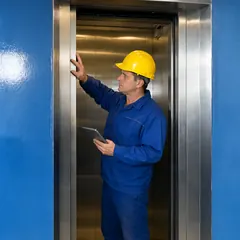
The company appoints its most highly qualified lift technician to supervise the other technicians and monitor the condition of the lifts it maintains (Art. 8). Servicing, repair and fault-finding are done by at least two lift technicians, who hang warning signs on the landing doors (Art. 9(3)).
How often are functional checks carried out
| Activity | Frequency or deadline | Legal basis |
|---|---|---|
| Functional checks and servicing | Per the manufacturer's instructions; if no interval is set for the checks — at least every 30 days | Art. 9(2) |
| Emergency service (freeing passengers, assistance in accidents) | 24 hours, uninterrupted; response within 1 hour of the call | Art. 9(1)(5) and (4) |
| Fluid cleanliness check (hydraulic lifts) | At least once a year, with a report | Art. 9(9) |
| Notifying GD IDTN of contracts concluded and ended | By the end of each quarter | Art. 9(5) |
| Keeping the lift file | At least 10 years | Art. 9a(1) |
The annex to the Ordinance lists what the functional check covers: car and landing push-buttons and car lighting, landing doors and locks, the lifting machine, overspeed governor and final limit switch, the control panel, the stop button and, for hydraulic lifts, the power unit, valve block and jack.
The lift log and file
- Log (дневник) — the company records the lift's technical condition and the results of checks and repairs; technicians enter the date, their name and signature (Art. 9(1)(4)). The log is kept in the machine room or, if there is none, in the control cabinet (Art. 9(6)).
- Company file (досие) — for each lift, with drawings, diagrams, test reports, quality documents for replaced parts, declarations of conformity for replaced safety components and payment documents; kept for at least 10 years and shown to GD IDTN on request (Art. 9a).
- DAMTN (State Agency for Metrology and Technical Surveillance) information system — the company enters data on all maintenance, repair and reconstruction work it carries out (Art. 9(10)).
After a repair or reconstruction, the company immediately notifies the supervision body that registered the lift and provides copies of the drawings, quality documents and declarations for replaced safety components (Art. 9(7)).
When the maintenance company stops the lift
The company notifies the user in writing and does not allow operation when the lift does not meet the requirements, is not registered, has not had its technical inspection or has been found unfit, or lacks the conformity marking (Art. 7a). For the faults listed in Art. 10(1) — such as movement with a door open, a faulty overspeed governor or safety gear, worn ropes — the lift is stopped until they are fixed, and the company notifies the supervision body and/or GD IDTN (Art. 10(2)). If the user does not request a fault to be fixed within 30 days, the company notifies GD IDTN (Art. 9(8)).
Maintenance does not replace the technical inspection. ESTIMA KM Ltd, as licensed technical supervision body (licence No. 417), carries out the inspections, while the maintenance contract stays with the registered maintenance company. See technical supervision of lifts.
Sources
- Ordinance on the Safe Operation and Technical Supervision of Lifts — Art. 7, Art. 7a, Art. 8, Art. 9, Art. 9a, Art. 10, Art. 10a, Art. 12, Art. 16; § 1, pt. 5 of the Additional Provisions; annex to Art. 9, para. 1, pt. 2
This article is for information and does not replace the text of the legal act.