In this article
What counts as lift reconstruction under the ordinance
The Ordinance on the Safe Operation and Technical Supervision of Lifts does not use the word “modernisation”. Whether work is reconstruction, repair or maintenance depends on the definitions in its Additional Provisions.
Reconstruction (преустройство, § 1(3)) is any of the following:
- a change to the rated load, travel height, car mass or speed;
- a change to the structure of the shaft or the machine room;
- a change to the electrical control circuit or its elements;
- replacing a safety component with one that has different technical characteristics.
Repair (ремонт, § 1(6)) is replacing a main component – lifting machine, car, control panel and the like – with an original part, or replacing a safety component with one of the same technical characteristics. Maintenance (§ 1(5)) also covers repairing or replacing parts with original ones where the lift’s technical characteristics do not change.
How to tell repair from reconstruction
The practical rule follows from the definitions: if the lift ends up with different technical characteristics or a different control circuit, it is reconstruction. The table sums up the consequences.
| Work | Legal category | What follows |
|---|---|---|
| New speed, rated load, travel height or car mass | Reconstruction (§ 1(3)) | Notice within 7 days and an additional inspection (Art. 24(1)(3) and (3)) |
| Change to the control circuit or its elements | Reconstruction (§ 1(3)) | Same |
| Safety component with different characteristics | Reconstruction (§ 1(3)) | Same |
| Replacing the lifting machine, traction sheave, hydraulic jack, suspension ropes, overspeed governor or safety gear | Repair, if the part is original or has the same characteristics (§ 1(6)) | Additional inspection (Art. 24(1)(5)) with quality documents and the declaration of conformity of replaced safety components (Art. 24(5)) |
| Other repair | Repair (§ 1(6)) | The supervision body checks the lift within 15 days of receiving the documents (Art. 28a) |
Who may reconstruct a lift
The user may sign a written reconstruction contract only with a company entered in the register under Art. 36(1) of the Technical Requirements for Products Act (Art. 7(1)). If a lift was reconstructed by an unregistered company, the user must stop using it immediately (Art. 7(3)). Subcontractors are allowed only with the user’s written consent (Art. 7(5)).
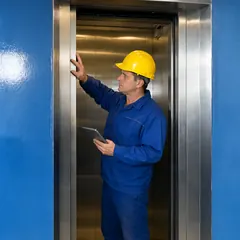
Reconstruction is carried out jointly by at least two lift fitters, who hang warning signs on the landing doors (Art. 9(3)).
The company doing the reconstruction must assess the risks and eliminate or reduce them while meeting the essential requirements of the applicable ordinances (§ 1a(1) of the Additional Provisions).
Which documents the user receives after reconstruction
Under § 1a(2) of the Additional Provisions, the company that did the work hands the user:
- an explanatory note on the changes made;
- the technical documentation the reconstruction followed;
- quality certificates for the materials and components used;
- a declaration that it assessed the risks and that the reconstruction meets the essential requirements.
The same company records the work in the lift logbook, notifies the supervision body the lift is registered with immediately, and gives it copies of drawings, schematics, quality documents and declarations of conformity of replaced safety components (Art. 9(7)). It keeps a file on the lift for at least 10 years (Art. 9a(1)), and the user and the supervision body add the reconstruction documents to their own file (Art. 31(3)).
The additional inspection after reconstruction, step by step
- The user informs the maintenance company of the reconstruction if it did not do the work, and before the lift is put back into service (Art. 13a(1)).
- The user notifies the supervision body within 7 days of the reconstruction (Art. 24(3)).
- The user files a written request for an additional inspection with the § 1a(2) documents attached (Art. 24(2) and (4)). The inspection is carried out within two weeks of the request.
- The inspection takes place in the presence of the user and the company that did the reconstruction, which provides qualified staff, measuring equipment, test weights and electricity (Art. 25(1) and (2)).
- The lift is checked against the documents and the tests under Art. 26(1) are carried out.
- The result is entered in the inspection book as an inspection record, with a conclusion on fitness and the date of the next periodic inspection (Art. 27(2)), and a sticker is placed in the car (Art. 25(3)).
In a condominium building these duties fall to the manager or the chair of the management board (§ 1b of the Additional Provisions).
The safety upgrades required by Chapter Five
Chapter Five of the ordinance (Arts. 38–40) requires existing lifts to have a load control device or a restricted car floor area, emergency lighting, shaft lighting, emergency stop devices, an alarm with two-way communication and a toe guard under the car. The deadlines in § 12 of the Transitional Provisions to Council of Ministers Decree No. 62 of 2014 have passed – the last one, for toe guards in residential buildings, was 31 December 2023. If a measure is missing, the user and the maintenance company must stop the lift (§ 12(2)).
As a technical supervision body with licence No. 417, ESTIMA KM carries out additional inspections after reconstruction. See technical supervision of lifts for the service and ESTIMA KM offices to book. Related: when an additional inspection is required and what lift maintenance involves.
Sources
- Ordinance on the Safe Operation and Technical Supervision of Lifts — § 1, pt. 3, 5 and 6 of the Additional Provisions; § 1a of the Additional Provisions; Art. 7; Art. 9, para. 3 and 7; Art. 9a; Art. 13a; Art. 24, para. 1–4; Art. 25; Art. 26; Art. 27; Art. 31; Art. 38–40; § 12 of the Transitional Provisions of CoM Decree No. 62/2014 (ДВ, бр. 27/2014)
This article is for information and does not replace the text of the legal act.